Smokin’ in the Sun
The peak season for Southern Europe’s ferry fleets is in full swing with chartered, elderly and seasonal tonnage pressed into service alongside the regular ships to cope with the seasonal demand.
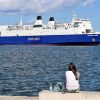
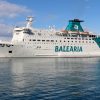
One thing that is notable from sailing in the area in recent times has been the dark and oily emissions from many of the ferries’ funnels. Ever-higher fuel costs have meant that many operators have opted for the lowest grade fuel oils available, presumably after considering the potential adverse effects this can have on the machinery against the cost savings. The results in terms of emissions from the ships themselves are quite spectacular – though hardly environmentally friendly. Here are a few images from the past year or so of Southern Europe’s ferries, and the results of what their owners have been feeding them.
Cool Hollandica conquers Stena Blandica
Despite being one of the world’s most successful ferry companies, the mundanity of Stena Line’s modern on board offering has always been puzzling, almost as if the company were determined to portray a ferry crossing as something everyday, nothing to get excited about. The food has never been too much to write home about and the decor from ship to ship was broadly consistent – there were the myriad different ‘Globetrotter’s, dear old Spike’s Sports Bar, Rudi’s Diner or, latterly, the dreaded Food City. Perhaps this familiarity was meant to be reassuring. For a company with such a wide variety of operations I have always found it rather constraining and the chosen decor somewhat depressing – descriptions of floating motorway service stations have not been far from the mark.
I will not, cannot, argue though against Stena’s success. There was once a memorable, possibly apocriphal, quote from Gothenburg that the company just couldn’t find enough things to do with its money. In the ferry part of the Stena sphere, in addition to operating ships, that money was made from building and rebuilding, buying and selling, predicting how the market was going to grow and ordering the right ships at just the right time – when prices were cheap, yards were desperate or demand about to explode.
Yet I had wondered if no one in Gothenburg in more recent times has ever really understood anything other than the freight market, that to many passengers even the shortest ferry crossing IS extraordinary and perhaps the experience deserves to be a little exceptional.
Despite being founded on a philosophy little short of ‘pile em high and sell em cheap’ earlier Stena ships were in many ways very beautiful indeed: the Stena Danica of 1969 ranks as perhaps the most beautiful ever Swedish ferry, inside and out. The Yugoslav quartet of the early 1970s were rather striking when one got past the flower power touches; the ‘Danica’ and ‘Jutlandica’ of 1983 as built actually were rather lovely and even the potentially soul-lessly huge Kiel ships of 1987/88 had endearing touches.
In the 1990s however what we can call the ‘Stena Blandica’ look took over. Wipe clean surfaces and slightly cheap looking shiny laminate flooring predominated. Worst of all, the desire to apply this look to every ship, regardless of service, took over and so, for example, one found on the overnight ships ‘Germanica’ and ‘Scandinavica’ where once there had been a series of delightful inter-connected à la carte restaurants a dreary Food City was installed instead. Passenger numbers have fallen dramatically from their peak: social and economic factors outside Stena’s control doubtless accounts for much of this yet one still wonders if Stena needlessly abandoned some of the non-transport market it once had.
Food City has now been discarded – the standardisation of onboard names and styles remains however. Yet, in recent times, there has been a marked uptick: starting with the Irish Sea fleet, suddenly Stena has endeavoured to decorate its ships in a most Scando-trendy and sympathetic style. The 2008 and 2009 refits of the Stenas Voyager, Caledonia and Nordica were perhaps the first hints of this movement, whilst the rebuild of the newly acquired Stena Navigator was the first really coherent evidence.
Which brings us, at last, to the Stena Hollandica, newly built for the Harwich-Hook of Holland route. Here, for once cast free from the constraints of converting existing tonnage, Stena’s house designers, Figura, had the chance to show just what they could achieve. A first glance of the ship’s guide is all too familiar: here is your C-View Bar, there your ‘Taste’ Buffet and over there a Riva Bar. Yet despite the familiarity somehow the whole coheres in a quite striking way. Carpets, seating, some bulkhead finishes and even layouts are replicated from other recent ships yet now it all makes sense and is often quite beautiful. Some unpleasant finishes remain such as a couple of the once uniform shiny metallic ceilings; the outside decks have, with more work still to do, thus far failed to remotely replicate the progressiveness of those on the ‘Navigator’. Yet these are quibbles, for in the ‘Hollandica’ Stena have introduced probably the newbuild ferry of 2010. One thing which is striking is the choice of a wood-effect laminate for many of the bulkheads in the corridors and arcades. This is all a mirage of course – doubtless there is not a single grain of wood in any of the wall panelling – and one could choose to take them to task for choosing effect over reality. However the effect is to make the ship feel distinctly warm in a quite endearingly old-fashioned way, perfect for an overnight ship.
Stena Line has since the loss of Duty Free focussed on freight – and the ‘Hollandica’s vast vehicle decks show that for good reason this will continue to be the case. But the passenger side did seem to have become a little neglected: the agonised debate on Landgången as to why the Stena-dominated Swedish West Coast can no longer support “cruise ferries” whereas on the East Coast ex-Stockholm mini cruises continue to thrive offers a few pointers in what could be perceived to have gone wrong. “Sterile” and “easy to clean” are two descriptions from that discussion which apply certainly to the current state of the Stena Danica, rebuilt in 2003 along much the same lines as Fishguard’s Stena Europe. The ‘Danica’, on the company’s premier route, deserves more than any other ship to be rescued from its sad ‘Blandica’ era and given just a little hint of the ‘Hollandica’ treatment. And maybe, just maybe, Stena will discover that people in the company’s home town will once more feel the urge to head out to sea – and that beautiful ships and profitable services are not as mutually exclusive as they perhaps had come to believe.
Blast from the past: Appia
The Appia of 1961 was the first car ferry of the Italian state-controlled operator Adriatica. She joined the equally new Greek (Hellenic Mediterranean Lines)-owned Egnatia on a ground-breaking joint service from Brindisi to Corfu, Igoumenitsa and Patras, the Adriatic’s first proper car ferry operation. The ships, which proved a great success, took their names from the two Roman roads which, on their respective sides of the sea, connected Rome with Constantinople (Istanbul). We will return to the Egnatia and HML at a later date – unlike their Greek counterparts, Adriatica still exists, in a much denuded form, as a small and seemingly unwanted division of Tirrenia. The failure of either operator to properly build on the early success of the Egnatia and Appia has to be viewed as something of a tragedy given the possibilities that existed in the Adriatic market, as exemplified today by the modern and heretofore broadly profitable services of relative newcomers like Minoan Lines, ANEK and Superfast.The Appia was as far removed as can be imagined from the current speedy leviathans yet, at her introduction, she was fairly revolutionary – Italy’s first drive-on international car ferry. Her inaugural brochure proclaims “a new, comfortable and fast means of conveyance; she is the answer to the requirements of modern tourism, of which motoring is so great a part. The crossing between Brindisi and the west coast of Greece takes approximately eight hours and can be made in comfort at remarkably little expense.
“If desired the crossing can be extended to take in the sea trip between Igoumenitsa and Patras – this trip, always made in daylight hours, is of the greatest interest, the island scenery being unfailingly beautiful”.
The ship in size and speed seems quite puny now – her two Fiat diesel engines providing a 17 knot service speed which powered her 706 overnight passengers on the 19 and a half hour (with a following wind) through crossing to Patras.
Later Adriatica brochures would detail her onboard delights: “a one class ship with dayroom, bar, restaurant, swimming pool, lido, snack bar, promenades and sun decks. There is also an information service on board, a shop, automatic dispensers of hot and cold drinks and – an entirely new idea – telecinema equipment which transmits to various parts of the ship normal television programmes, films and live entertainments and reportage. No effort has been spared to make the passenger comfortable, the decor especially demonstrates the designers’ desire to capture the holiday mood, without sacrificing any elegance or convenience.”
That decor was very slightly more staid than might have been expected had the Appia been built slightly further into the ’60s but it was not unattractive and the traditional Italian pegboard ceilings and polished linoleum floors could be found throughout. The ship’s nicely-detailed circular swimming pool featured an eminently photographable water slide which slotted in between a gap in the mainmast. Cabin space was for just 200, the balance of her passenger load being accommodated on deck or in the various reclining seat lounges, the largest being located just beneath the bridge. The relatively small vehicle deck (for up to 100 cars) had cabins running alongside at the upper level leaving a small centreline area astern for up to six coaches to be carried in an area aft of a very wide centre casing.

Astern on the lower of the main passenger decks, Deck C, was the main restaurant, as conceived (above) and completed (below).

Astern on this deck was the “Sala Soggiorno” or Living Room, seen here as visualised in the inaugural brochure.

The ship offered seven 'Deluxe' two-berth cabins with private facilities including a full bath as well as one suite on C Deck, complete with private sitting area with TV and radio, as seen here.

The bulk of the ship's cabin accommodation comprised Pullman-style rooms without facilities, which could be converted to night (above) or day (below) use.
The Appia gave Adriatica loyal service for over 30 years, finally being sold to Indian interests in 1992 who briefly operated her as the Fibi before she headed to Alang for scrapping in 1995.
Her famous operators still had a few good years left, but their final conventional purpose-builds for the international services, the incredible trio of flops the Palladio, Sansovino and Laurana, were a dangerous warning sign that all was not well. Ships and time-honoured routes were quickly shed as the operation lost its independence and fell under a seemingly disinterested Tirrenia management in Naples. In 2010, the year in which perhaps Adriatica’s most famous ship, the ex-Ausonia, finally headed for scrap, there are further serious doubts about the future of the sole remaining service, from Bari to Durres in Albania, of what is now simply Tirrenia’s Divisione Adriatica.
The Paddle Steamer Ryde
Some pictures of the pitiable remains of the paddle steamer Ryde seen at Binfield on 3 May 2010.
Completed by Denny’s in Dumbarton in 1937, the ship operated between Portsmouth and Ryde Pier for a period stretching over 30 years, interrupted by war service during which she participated in the Dunkirk evacuation and supported on the Normandy beaches. Latterly, she was used only seasonally before being retired in 1969. She has spent longer still in her post-service career, taken to a site adjacent to what is now the Binfield Marina on the Isle of Wight where, as a hotel, bar and nightclub she was closed more often than not.
The millpond in which she was originally berthed has long since mostly dried up, leaving the ship entombed in the mud. A couple of years ago, the funnel collapsed during a storm and, more recently, she has been partially demolished.
There can be no come back for the ship from here.
Farewell Mette Mols, Balkanija, Istra
A few weeks ago, Jadrolinija’s Istra was sold for scrapping in Turkey. As the Mette Mols, Mols Linien’s very first ship, she was the lead vessel of what became a very successful class of four completed by the Aalborg shipyard between 1966 and 1969. Passing to Jadrolinija in 1981, initially as the Balkanija, the Istra is the first of the quartet to pass for scrap.
Her demise is not entirely unexpected: for most of the past decade there have been rumours that every season may be her last. Her engines were in notoriously poor shape – one wonders if the engine room explosion which forced her passengers to flee in the lifeboats back in 1970 had any long-term impact. The Croatians made her work however and, although long since relegated from the coastal express or international services, she was still a local favourite as she chugged slowly along from Split to Stari Grad, Hvar Town, Vela Luka or Ubli.
On board she was a time warp: although she had been modified in places over the years, particularly with the addition of a Duty Free shop and a small number of cabins in part of the aft cafeteria, she was in many places still that pioneering little Danish domestic ferry right to the end and was maintained in pretty good general condition, all things considered. In her final seasons, even the former first class restaurant on the upper passenger deck was tidied up, the Italian rosewood panelling polished, white tablecloths laid and the tiny galley pressed into action to produce some unexpectedly good lunches.
But one knew it couldn’t last – with the local shipyards churning out new double-ended ferries at an alarming rate, supplemented by some second-hand Greek acquisitions of dubious quality, Jadrolinija’s fleet expansion was outpacing even the growth of the Croatian tourist industry and the older ships have, after decades of reliable and memorable service, finally started to make way. The Ivan Zajc was dispensed with for last year and even the glorious little Liburnija, the pride of the fleet, now faces an uncertain future.
After 29 years, one civil war, several post-war refugee sailings and the odd mishap, the Istra, one of the “legends” of Croatian coastal shipping, left her lay up berth in Šibenik on 6 May bound for Aliaga.
From the scrapyard: Oujda
The pair of stretched ‘Super Vikings’, Oujda (ex-Viking Venturer/ Pride of Hampshire) and Mogador (ex-Viking Valiant/Pride of Le Havre/Cherbourg) were sold for scrap earlier in the year and Unique Marine Machinery have, in the process, taken posession of a couple of items from the former ship, in particular the ship’s bell and the builder’s plate from her 1986 rebuilding and these are now available for sale through their website.
The ships did not have entirely satisfactory final years, bouncing around between COMANAV charters and service for their owners El Salam. COMANAV latterly were able to source better-quality charter tonnage and the ships disappeared to the Red Sea, never to return.